Sunday, March 10, 2013

The Plate Tectonics

  The plate tectonics states that Earth is like pieces of puzzles.The evidence is fossils, continents, deserts... Animals like cynognathus, glossapteris, lystrosaurus and mesosaurus come together and showed that continents are like puzzle. All continents come together. The Earth's interior made up of four layers. Inner core is the first one and its solid. The second one is outer core and its liquid (Very hot). The third one is mantle, its also liquid. The forth one is where we live called crust and its of course solid, if it was liquid we would not live in the Earth. Also there are two crusts which are oceanic crust and continental crust. oceanic crust is the ocean, water. Continental crust is the land.
 The theory also says that plate tectonic is the movement and because of this movement Earth changes. Plate boundary is when the plates meet. There are three different kind of plate boundary. Convergent boundary is when plates come together and forms volcanoes and mountains. There different type of volcanoes and mountains, Shield volcano, composite volcano,and cinder cone, those volcanoes also have similarities and differences. Folded mountains and fault block mountains form s differently too. Divergent plate boundary is when plates move apart from each other and forms rift valleys, mid ridge ocean. The transform plate boundary is when plates slide past each other and forms earthquakes and tsunamis.  


Continental drift
 is a theory thought by Alferd Wagener, it says that that continents are like puzzles and it can come together. A lot of people thought that he is crazy, but overtime peoples started to see the effects. Then they believed in that theory. Convection currents makes the plates move. Because the mantle makes the pressure to go up of it hotness, when it goes up there will be no effect. Because the crust is not hot. 

In conclusion I believe in theory of plate tectonics. Because all the evidences shows that earth can move and the continents can come together. There are a lot of effects of the movement. Like earthquakes, tsunamis, different type of mountains and ect... 


Reflection

                                                    Reflection

In this project I enjoyed working individually and I had a chance choosing topic. We had different kind of topics. After when we done with one activities Ms Kara tested us on the activity that we did. And it wasn't difficult. Some activities was confusing. But I studied and got grade by my teacher. nothing was challenged for me. I learned working individually. Also I learned how to make lab. If I had chance to change something about this project, it would be nothing. Everything is perfect. 

Monday, February 25, 2013

Type of movements

           Comparing and contrasting different type of movements

 Divergent boundaries when plates move apart from each other. An example is Iceland, where the place is splitting along the mid-Atlantic ridge, a divergent boundary between the North American and Eurasian Plates. Over time, if there is a complete split, the two land masses will become separated and the body of water surrounding Iceland will fill in the gap.
 Transform fault boundaries are where two plates are sliding horizontally past one another and thus form faults. An example is the boundary on the west coast of the United States.

Convergent boundary is when two plates come together. There are three types of different convergent boundaries, Oceanic- continental, oceanic-oceanic, continental-continental. This type of boundary is not as common as the other ones in recent times. 


Wednesday, October 24, 2012

Rock Cycle

                                                          Rock Cycle

There are three types of different rock which are igneous rocks, sedimentary rocks and metamorphic rocks. These rocks forms differently.Igneous rocks forms when magma or lava cools down. Igneous rock have two kind of different types which are extrusive and intrusive.Extrusive igneous rock have small crystals, and forms outside of the volcano. Intrusive igneous rock have big crystals and forms inside of the volcano. Sedimentary rocks forms by compaction and cementation of sediments. Sedimentary rocks have three different kind of types which are clastic, bioclastic and crystalline. Clastic sedimentary rock is just piece of rock. Bioclastic sedimentary rock forms from organics. And crystalline rock is a rock that forms from liquid. Metamorphic rock forms by heat and pressure. Metamorphic rock has two types which are foliated and non-foliated. foliated has layers and non-foliated is without layers.

When magma comes out from the volcano it gets cold and turns to Igneous rock. After igneous rock by weathering and erosin gets in small pieces. Those rocks get together and glues together and becomes sedimentary rock. Inside the underground sedimentary rock will get heat and pressure and becomes metamorphic rock. After going deeper and deeper metamorphic rock will melt down and comes as lava. That's how the rock cycle happens.


                                                      Vocabulary Words

Metamorphic rock- forms by heat and pressure
Sedimentary rock- forms by compaction and cementation
Igneous rock- forms cooling magma
Weathering-rain, wind, ice that breaks the rock into pieces
Erosin- Moving material things from one place to another
Sediments- broken pieces of rock
Compaction- push together
Cementation- glue it together

                                                           Rock Types

Sedimentary rock.


 Clastic-  just piece of rock.
 Bioclastic- forms from organics.
 Crystalline- rock forms from liquid.

Igneous Rock

 Extrusive- has small crystals, forms outside of the volcano.
 Intrusive- has big crystals, forms inside of the volcano.

 Metamorphic Rock

 Foliated- with layers
 Non-foliated-  without layers

Crystals


1. Crystals
In science class we grew up two types of crystals. We added halite and epsomite in the water. We added each time two spoons of halite and epsomite in the broil water. After the crystals were ready, we putted near the window. We observed every day, and recorded. And after days the crystals started to grow up.

2. Mineral Properties
 Color- the color of the mineral


Luster- metallic or non metallic


http://upload.wikimedia.org/wikipedia/commons/thumb/8/8f/Apollo_synthetic_diamond.jpg/220px-Apollo_synthetic_diamond.jpg


Hardness- How hard is the crystal.


http://upload.wikimedia.org/wikipedia/commons/thumb/5/59/Fluorita_green.jpeg/220px-Fluorita_green.jpeg


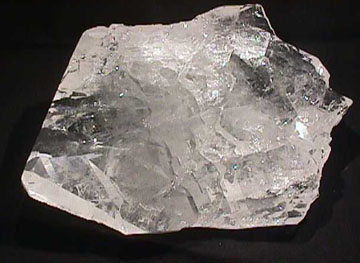
Cleavage- When crystal breaks even. 


http://www.rockhoundingar.com/_images/Lgnatfrac.jpegFracture-When crystal breaks unevenly.


3. Mineral Identification
Mineral: olivine
Color-green
Luster- non metallic
Cleavage
Formula- (Fe,Mg)2Sio4
Mineral: Graphite
Color- silver to gray
Luster metallic
Cleavage
Formula- C